
NPD Lockup Release Paths
Nantucket Police at 4 Fairgrounds Road is the first local custodian after many island arrests. People remain there while officers complete booking and while bail, an initial court appearance, a lawful release, or off-island transport is arranged. Stationhouse bail, personal recognizance, or a clerk-magistrate or judge’s order can end custody locally. That is a release from the lockup.
A move by the Nantucket County Sheriff to Barnstable County Correctional Facility is different. It is continued custody. The police transfer record should name the receiving agency or destination, and BCCF then becomes the custodian for later release questions. A police entry saying that the person left NPD does not by itself show that the person entered the community. Always read the release authority, transfer notation, and destination together.
| NPD outcome | What it means | Next source |
|---|---|---|
| Bail or recognizance | Local physical release while the case may remain pending | NPD transaction and court docket |
| Court-ordered release | Release based on a legal order after processing | Docket plus NPD exit time |
| Transfer to BCCF | Custody continues on the mainland | BCSO admission and later release record |
| Other agency pickup | NPD custody ends but another custody may begin | Named receiving agency |
Confirm an NPD Lockup Release
NPD does not publish a live inmate list, recent-booking page, release feed, booking-photo gallery, or released-person archive. A web search cannot settle whether a named person was released. Use the police record for physical custody and the court record for legal authority. If the police record shows transfer, keep tracing the person rather than treating the handoff as release.
- Gather the full legal name, approximate arrest date, incident or booking number, and court docket number if known.
- Call NPD Public Records at 508-325-4166 or use the town’s JustFOIA portal. Ask for the adult lockup release or transfer record tied to the event.
- Request the time custody ended, recorded release authority, and destination or receiving agency. Ask for releasable portions if part of the file is restricted.
- Use the exact docket number in MassCourts to verify bail, recognizance, dismissal, sentence, warrant, or another court event.
- If NPD records a BCCF transfer, continue with BCSO. The BCCF release-record route covers that mainland stage.
Note: Use the person’s full legal name and a narrow arrest-date range to reduce mistaken matches and speed the record search.
NPD Release Records Contact
The Town and County of Nantucket identifies a Police Department Records Access Officer and provides an online request channel. The weekday records listing is separate from 24-hour dispatch. Use Public Records or the portal for documents. Dispatch is more suitable for an immediate operational question, not a broad request for archived paperwork.
Nantucket Police Department
Police RAO: Deputy Chief Charles Gibson
4 Fairgrounds Road
Nantucket, MA 02554
Public Records: 508-325-4166
Dispatch: 508-228-1212, 24 hours
Fax: 508-228-7246
Records listing: Monday-Friday, 8:00 a.m.-4:00 p.m.
The official Nantucket public-records page displays the police RAO, request access, contact information, and listed hours.
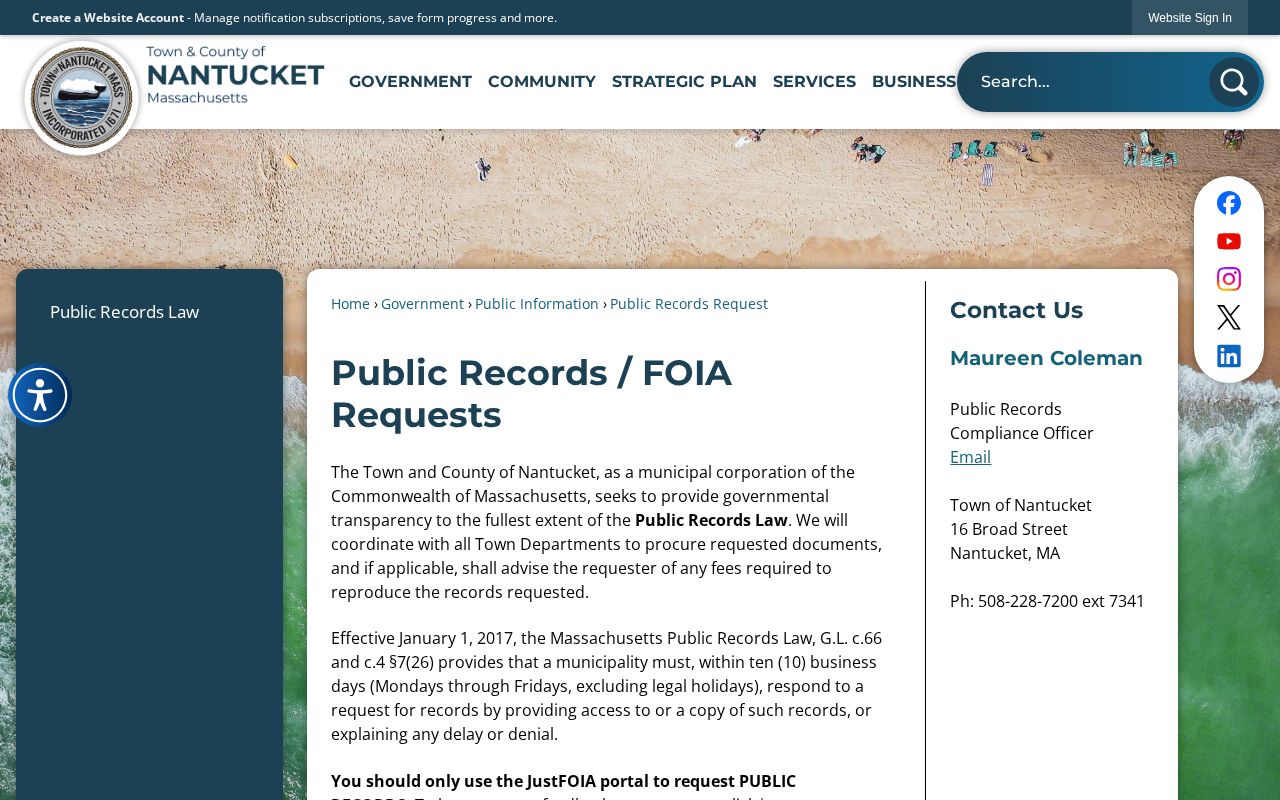
The source confirms that police records, rather than a public lockup roster, are the official access channel for a past local release or transfer.
Note: Public Records and 24-hour dispatch serve different needs, so direct an archived document request to the records channel.
Request NPD Release Details
A useful request asks NPD for records already kept in the normal course of work. It should not ask the department to write a new account. Name one adult and one event. Include the incident or docket number and a narrow date range when possible. Ask for electronic copies and reasonably segregable nonexempt portions.
Request the arrest or booking record, incident or booking number, time placed in lockup, bail determination, date and time custody ended, recorded release authority, and whether the person was released at the station or transferred. If transferred, ask for the receiving agency or facility. The property-release acknowledgment and booking photograph can also be requested if they exist and may lawfully be disclosed.
- Release authority
- The legal basis recorded for ending NPD custody, such as bail, recognizance, or a court order.
- Transfer
- A handoff to another custodian. It is not release to the community.
- Physical release time
- The time NPD custody actually ended, which may follow a court decision or bail review.
- Receiving agency
- The office or facility that accepted custody after NPD.
If an active investigation or another protection limits the main report, ask for the daily-log or arrest-register entry and the releasable custody-change transaction. Massachusetts police logs can carry arrest and charge information subject to protected-entry exceptions. The town’s online portal is a submission channel, not a name-search archive.
Use exact terms in follow-up correspondence. “Time released from NPD” asks when police custody ended. “Released to the community” asks for the destination as well as the time. “Transferred to BCCF” asks for the receiving facility and handoff. Those are not interchangeable. If the response provides only a court order, ask whether NPD also maintains the transaction showing when staff carried it out. If it provides only a transfer date, continue with the receiving custodian.
NPD Release and Court Records
A docket and a lockup transaction answer different questions. The docket may show bail, recognizance, a dismissal, a sentence, probation, a warrant, or a later order. The NPD record shows when the police physically acted on the authority and whether another agency received the person. A court hearing time should not be reported as the lockup exit time unless the custodian record confirms it.
Most Massachusetts criminal cases cannot be searched remotely by a person’s name. The exact docket number is normally required. Obtain it from arrest paperwork, NPD, the clerk, or another case document. Nantucket District Court and Nantucket County Superior Court share 16 Broad Street, but they have different jurisdiction, phone numbers, emails, and hours. Select the correct court department and Nantucket location before entering every character and leading zero in the case number.
A missing docket result can reflect a number mismatch, remote-access limits, sealing, expungement, impoundment, or another restriction. It does not erase the underlying custody event. For a historical release, preserve both the police response and the court material so the legal and physical timelines remain distinct.
Why NPD Has No Jail Release List
Nantucket is the Commonwealth’s only sheriff jurisdiction without a conventional jail or house of correction. The police lockup handles the island’s first stage, and a few sheriff contingency cells may cover rare transport delays. The Nantucket Sheriff then moves people by boat or plane to Barnstable when incarceration continues. This history explains why the Police Department does not function like a county sheriff running a long-term jail and public release list.
The phrase “Nantucket County Jail” can send a search in the wrong direction. For a short local stay, NPD owns the release or transfer record. For incarceration after mainland transport, BCSO owns the admission and later release record. The Nantucket court remains the durable local case trail in either path. Naming the right stage in a request saves time and prevents a BCCF transfer from being mistaken for community release.
NPD Release Record Retention
No official page promises that lockup or release records remain searchable online for any set window. There is no such public search. The municipal retention schedule instead sets record-series rules: police booking sheets are retained through prosecution and appeals, cell-monitoring reports have a separate period, and the police blotter or log is kept permanently. Litigation holds and other law can extend retention, while sealing, expungement, juvenile confidentiality, investigation protections, or court orders can restrict access.
For that reason, submit a focused records request even if the event is old. Do not infer that a missing web result means no arrest or release occurred. Ask the RAO to cite an exemption or explain a redaction, and request the nonexempt balance. Written requests also create the clearest path if clarification, a fee estimate, or an appeal becomes necessary.
Massachusetts law generally calls for a response without unreasonable delay and within ten business days, but that response may be production, an estimate or schedule, a request for clarification, or a reasoned denial. It is not a promise that every requested record will arrive in ten days. Broad requests can take more work and cost more. A precise person, event, and date range gives the RAO a better chance to locate the right lockup file without sweeping unrelated records.
Note: Personnel and portal details can change, so the current town public-records page should control over an older saved contact name.