
Nantucket Parole and Probation Compared
Parole and probation can both place rules on a person in the community, but their legal sources differ. The Massachusetts Parole Board may release a person from incarceration before the maximum sentence ends. That person remains under Board jurisdiction. Probation is imposed by a judge and is managed by the Massachusetts Probation Service. A probation term may follow custody, begin after a suspended sentence, or be imposed without incarceration.
That difference controls the search. A Nantucket District Court docket may show that probation was part of the disposition. The Parole Board may publish a life-sentence decision or provide a record through its authorized process. Neither a docket entry nor a favorable parole vote proves the exact moment a person physically left a facility. For that fact, the releasing custodian's transaction is still needed.
| Point | Parole | Probation |
|---|---|---|
| Legal source | Release under Parole Board authority before the sentence maximum expires | A Trial Court sentence or order |
| Nantucket contact path | Massachusetts Parole Board and Region 8 | Nantucket District Court Probation Department |
| Public online clue | Published life-sentence decisions in eligible cases | Court docket disposition, when remotely accessible |
| Main access limit | No public roster of all parolees | Current compliance details are generally private without a signed release |
| End point | Maximum sentence, lawful termination, or other Board action | Court-ordered end or lawful early termination |
- Parole
- Conditional community release while the Parole Board still has jurisdiction over the sentence.
- Probation
- Court-ordered supervision in the community, with terms set through the criminal case.
- Discharge
- The formal end of a sentence or supervision authority, not merely departure from a jail.
- Absconder
- A supervised person alleged to have stopped reporting or left supervision without permission.
Verify Nantucket Post-Release Supervision
Start with the legal event, then use the office that owns the record. Nantucket has no local parole database. Most remote Massachusetts criminal cases also require the exact docket number, so a failed name search should not be treated as proof that supervision does not exist. The clerk, arrest paperwork, or police record may supply the number needed for the court search.
- Determine whether the case was a Nantucket District Court matter, a Nantucket Superior Court matter, a county sentence at Barnstable County Correctional Facility, or a state-prison sentence.
- Use the exact docket number in MassCourts and read the disposition and later events for probation, sentence, parole-related action, warrants, or termination.
- For a parole-eligible life case, search the Board's published Record of Decisions by name and year. Match the commitment number and hearing history.
- For another parole record, follow the Board's written request process. A third-party request needs the person's authorization and CORI release.
- For current probation information, the supervised person should ask the assigned officer about a signed release. Public callers should expect strict disclosure limits.
- Confirm the physical release separately with NPD, BCSO, or MA DOC. A supervision order does not supply the facility exit time.
A released Nantucket County person may also have no parole or probation at all. Bail, recognizance, a dismissed charge, time served, or expiration without supervision can lead to a community release. The broader custody and release-record path appears on the Nantucket County released inmate search.
Note: A public docket can identify the sentence, but it does not expose an officer's private notes or prove present compliance.
Nantucket Parole Records and Decisions
The Board's public exception is important but narrow. Its Life Sentence Record of Decisions publishes reasoned decisions by year and name. A decision may state the commitment number, hearing type and date, procedural history, vote, reasoning, future review period, and conditions attached to a grant. It does not function as a live list of all Nantucket County parolees.
A grant can come before physical release. The person may still need a lower-security placement, an approved home or residential plan, program completion, prosecutor clearance, or another required step. Changed facts can also trigger rescission procedures. For this reason, a decision date, an eligibility date, and a release date must remain separate in any Nantucket County parole record review.
The official decisions list shows how the Board publishes the subset of records open online.
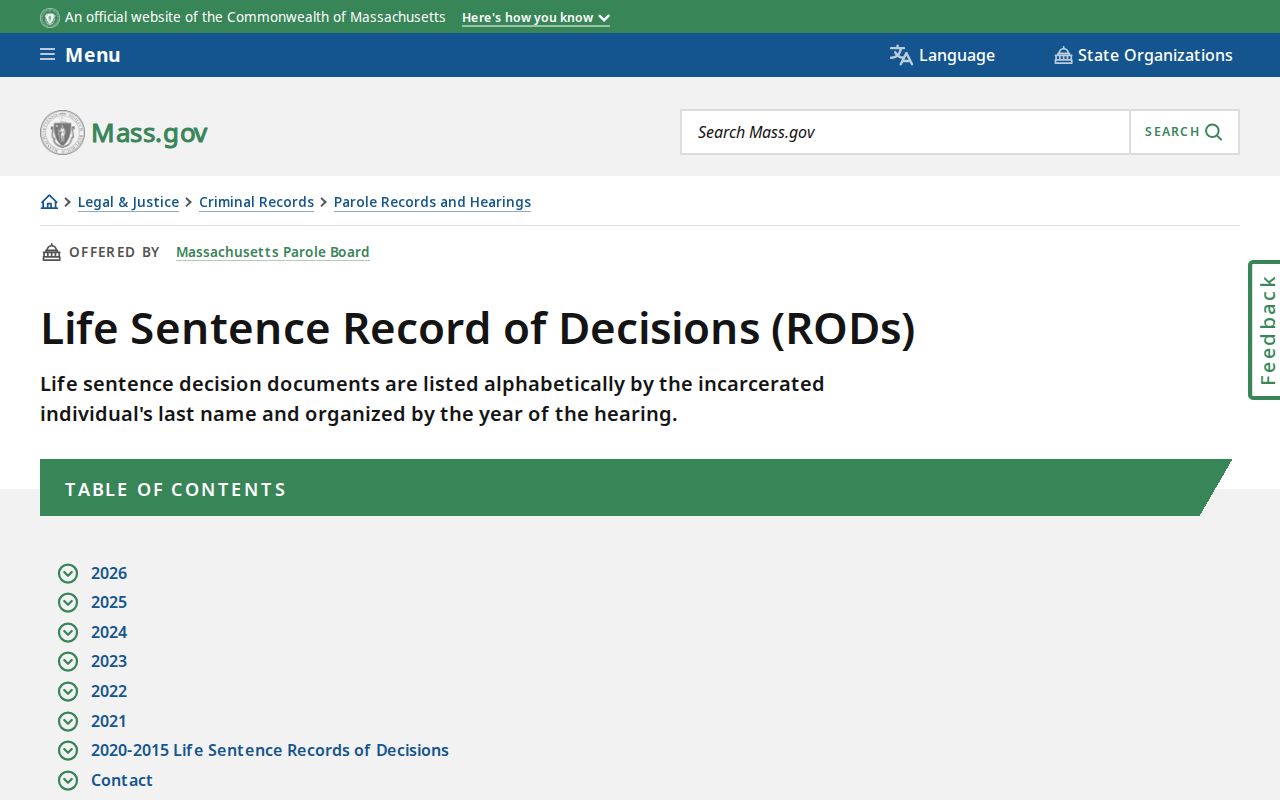
The list can establish that a decision exists, but the decision and releasing agency must be read before drawing a conclusion about release.
Nantucket Supervision Office Contacts
The offices serving Nantucket County are not in one building. Parole field service for the Cape and Islands is routed through Region 8 in Dartmouth. Criminal probation is based at Nantucket District Court. Assignments can change, so the regional or department line is more durable than an individual officer's name.
Massachusetts Parole Board, Region 8421 Faunce Corner Road, 2nd Floor
Dartmouth, MA 02747
508-995-6400, extension 3640
Monday through Friday, 9:00 a.m. to 5:00 p.m. Nantucket District Court Probation Department
16 Broad Street
Nantucket, MA 02554
508-228-3232
Monday through Friday, 8:30 a.m. to 4:30 p.m.
For an authorized parole record, the Office of General Counsel receives specific written requests at Massachusetts Parole Board, 12 Mercer Road, Natick, MA 01760. The main line is 508-650-4500, and the toll-free number is 866-480-6272. Public hours are listed as 8:45 a.m. to 5:00 p.m. on weekdays.
Nantucket Parole Hearing Records
The Massachusetts parole hearings gateway separates several types of proceedings. Institutional release, rescission, and revocation hearings occur at correctional facilities and are closed to the public. Life Sentence Unit hearings and most Central Office proceedings are public, apart from victim-access hearings. This distinction matters when a Nantucket County search returns a calendar but no open hearing record.
Life-sentence calendars are issued monthly. They identify a hearing date and time, the person, and whether the matter is an initial or review hearing. A calendar line is not a release grant. The later Record of Decision states the Board's result, while actual release can remain subject to conditions and processing.
Eligibility also varies. State prisoners ordinarily reach parole consideration after the judicial minimum as lawfully reduced. House-of-correction terms use a different framework, generally one-half of the aggregate term or two years, whichever is shorter, subject to mandatory minimums and other rules. Eligibility opens review. It does not compel the Board to release a person.
Note: Public life-sentence material is a defined exception, not evidence that every Nantucket County parole file is open online.
Nantucket Supervision Violations and Warrants
Supervision terms may include reporting, approved residence, travel limits, program participation, monitoring, and compliance with court or Board orders. A suspected violation can lead to investigation, a hearing, tighter conditions, a warrant, or a return to custody. The record must show which agency acted. A parole warrant and a probation warrant do not come from the same authority.
Parole Field Services conducts community visits, investigations, risk and need assessments, electronic-monitoring response, and violation reporting. The Board's Warrant and Apprehension Unit receives information about a wanted parolee at 617-376-6269. State Police dispatch is listed at 508-820-2121. These are reporting channels, not public status lookups. A person missing from a public wanted notice cannot be assumed compliant, discharged, or still supervised.
Probation status is similarly constrained. Massachusetts guidance says adult probation officers generally cannot discuss a probationer's current status with family, friends, neighbors, or other callers without a signed release. A public docket can show the original order and later public events, while internal case notes and present compliance remain separate.
Nantucket Release and Reentry Support
Island geography creates a practical split in post-release support. The Barnstable County Sheriff's Office Bridge Center is a mainland navigation hub for people after incarceration. Fairwinds Center is an on-island behavioral-health and crisis resource. Neither office confirms whether a person was released, placed on parole, or ordered to probation.
Before traveling, confirm the service, eligibility, appointment needs, and ferry plan. A person released from BCCF in Bourne is not automatically transported to Nantucket, and an on-island appointment does not change Region 8 parole reporting duties. Legal supervision questions still belong to the Parole Board or Nantucket District Court Probation Department.
Note: A reentry office can help with services, but it cannot replace the court or Parole Board as the status source.
How Nantucket Supervision Ends
A parolee normally remains under Board jurisdiction until the sentence maximum or aggregate maximum expires, unless parole ends earlier through lawful Board action. Physical release from prison is therefore not the same as discharge. The release record may establish the day custody changed, while a later Board record establishes when parole authority ended.
Probation ends under the court's order or a lawful termination process. Massachusetts probation compliance credits may advance termination for an eligible term after incarceration, but those credits do not change the earlier jail release date. The docket should be read for the imposed term and any later order. Current case details may still require authorized contact with probation.
Keep four dates distinct: custody exit, parole eligibility or probation start, supervision termination, and sentence discharge. When records conflict, request the existing document from the agency that created each event instead of merging the dates into one assumed release.